

Your guest journey is leaking somewhere. Maybe OTA guests arrive as strangers, or past regulars have quietly stopped coming back. The tempting move is to pick a fix and start building, and that is exactly how hotel groups end up sinking months into a guest app or a new email flow that solves the wrong problem.
Before you write a project brief, find out which leak is actually yours. Below are the five most common ones, and for each, the data signal that exposes it and a 30-day test you can run before committing real budget.
Search for ways to improve your guest journey and you will get the same article fifteen times, usually a numbered list of upsell tactics, app features, and check-in tweaks. The problem with idea lists is that they assume every leak is the same size, when in reality they are not. McKinsey put the prize at a 10 to 15 percent revenue uplift from getting personalisation right ("The value of getting personalization right or wrong is multiplying", 2021, updated 2024), which is real money, but the lift only lands if you fix the right leak. Patch the wrong one and you spend a quarter rebuilding pre-arrival emails for a property whose actual problem is that it never captures the guest email in the first place.
Bain's retention maths is the second reason to find the leak before you act, because a 5 percent lift in retention can produce 25 to 95 percent more profit (Frederick Reichheld, Loyalty Rules!, Bain & Company). Compounding works on the guests you already have, so if your funnel is leaking them out the back door, no front-of-funnel campaign will catch up.
So before you commit a quarter to anything, run the diagnostics below and see where your funnel is actually losing guests.

The pattern. A guest books through Booking.com or Expedia, the OTA sends the confirmation, and the hotel never gets a real email address or a proper profile into the PMS. The first time anyone at the property meets this guest is at the front desk.
The data signal. Pull a month of arrivals from your PMS, filter to OTA-sourced bookings, and count how many have a hotel-owned email captured before arrival. If the majority arrive without one, this is probably your largest leak. SiteMinder's Hotel Booking Trends 2025 shows direct booking share holding steady, which means the OTA share is not shrinking on its own and you have to pull the relationship back yourself.
The 30-day test. Send a branded pre-arrival email two days after the OTA booking confirms, asking for arrival time and dietary preferences, and the reply rate becomes your real email-capture rate. It will look low on day one. That is fine, because now you have a real number, and subject-line iteration alone can move it meaningfully within a quarter.
The pattern. Between booking and check-in there is nothing: no room-upgrade offer, no airport-transfer prompt, no expectation setting about breakfast or parking. The guest arrives cold, and the front desk does the upselling under time pressure, badly.
The data signal. Look at the share of stays where any pre-arrival message was sent and opened, then look at upsell revenue per arrival. If most pre-arrival messages go unopened, or upsell revenue per stay is close to zero, the silence is costing you.
The 30-day test. Run one pre-arrival email, sent five days out, with two upsell options priced clearly, and track open rate, click rate, and attach rate on the upsell. The campaign matters less than the baseline it gives you, because a baseline is something you can move.

The pattern. The same guest stays three times across two properties in your group, each booking comes through a different channel, sometimes with a slightly different email or a typo in the surname, and your PMS treats them as three separate guests. As a result, your CRM sends them the welcome email three times.
The data signal. Run a duplicate-profile report on the last 12 months, matching by phone, by email root, and by surname plus date of birth, and the overcount is your identity-loss rate. Groups running this report for the first time are usually surprised by how high the number is.
The 30-day test. Pick the top 100 duplicate clusters, merge them by hand, and write the merged profile back into the PMS, then track repeat-stay recognition at check-in for the next 30 days. The write-back is the part teams skip: merging profiles in the marketing tool alone is not enough, because unless the clean record lands back in the PMS, the front desk keeps greeting a repeat guest as a stranger. This is the leak that quietly kills loyalty programmes, and fixing it at scale means unifying guest data at the source rather than merging duplicates by hand forever.
The pattern. The guest checks out, and then there is silence for ten days, followed by a generic newsletter four weeks later. There is no thank-you and no review request at the moment the guest actually feels something about the stay.
The data signal. Measure time-from-check-out to first post-stay message. If it is over 48 hours for the majority of stays, you are likely missing the emotional window. Cross-reference that with your review volume on TripAdvisor and Google: the closer the prompt sits to check-out, the more likely the guest is to act while the stay is still fresh.
The 30-day test. Send a single email the morning after check-out with one question, "How was your stay?", where one reply path goes to a public review platform and a lower score routes to the GM. Measure reply rate and review velocity, and build from there with the rest of your post-stay journey.

The pattern. A guest who used to come twice a year has not booked in 14 months, and no one notices. Nothing is triggered by the absence: no tailored offer and no segmentation by lapsed status.
The data signal. Build a cohort of guests whose last stay was 4 to 12 months ago, and compare their re-book rate against guests in their first 90 days. If the lapsed cohort re-books at a fraction of the rate of recent guests and no winback campaign exists, the gap is recoverable. The winback signals that flag a drifting guest are worth setting up here too.
The 30-day test. Run a two-email winback flow, with one email acknowledging the absence and one with a date-flexible offer, then measure re-book rate over 60 days rather than 30. Winback is slower than the other leaks, but it compounds the hardest, because the retention maths from Bain lives here. Tie it into your loyalty programme and the same offers do double duty.
Tackling all five at once rarely works, so order them this way.
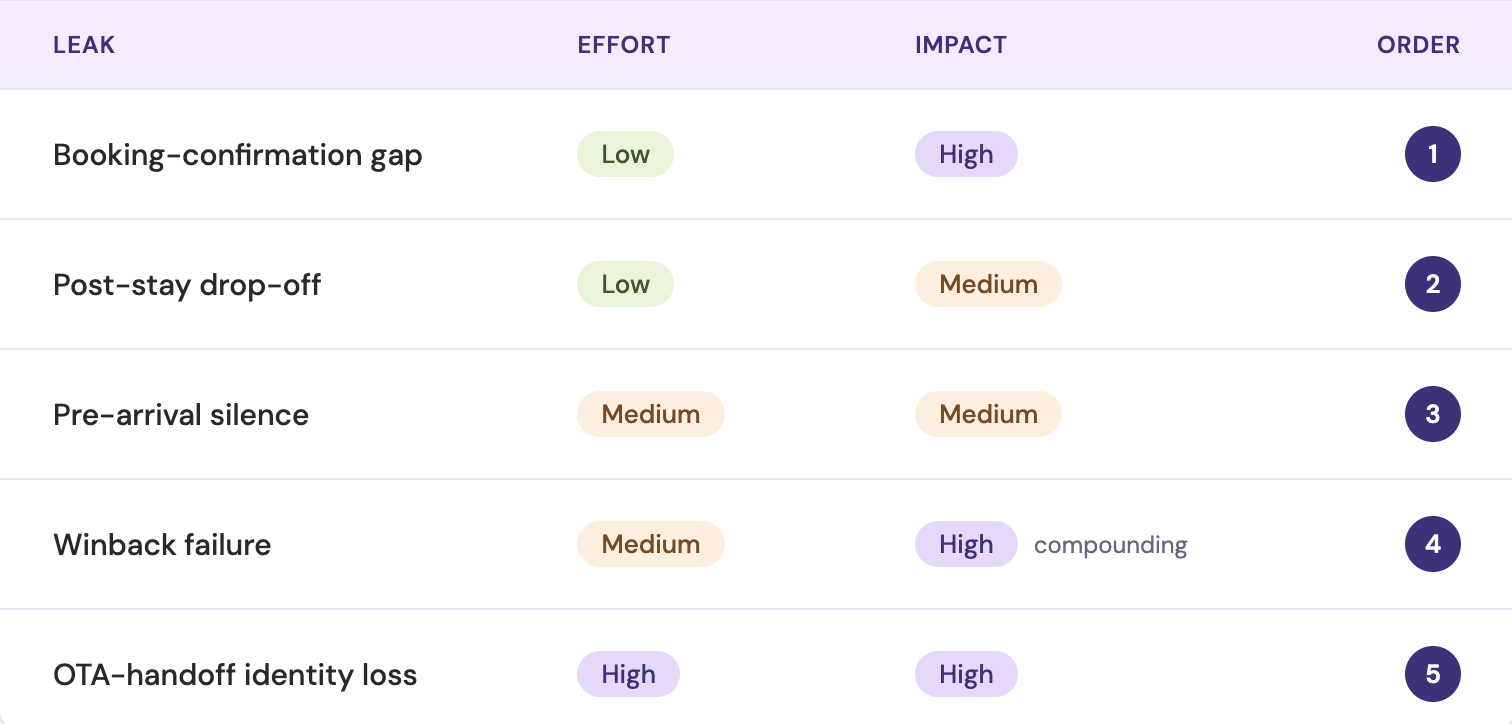
Identity loss is the hardest of the five to fix without proper data infrastructure, which is why it sits last despite being one of the biggest prizes. Plug the cheap leaks first to build internal credibility, and then tackle the data layer.
Pull one report: arrivals from the last 30 days, segmented by booking channel, with a column for whether a hotel-owned email was captured before arrival. That single number tells you whether leak one or leak three is your biggest problem, and from there the test is a fortnight of work, not a project.
Once you know which leak is yours, our guide to guest engagement metrics covers what to track next. But every guest journey improvement project should start the same way: find the leak first.
Are you ready to increase your revenue and build lasting guest relationships? Take the first step today.

.jpg)
.png)
.jpg)
