.jpg)

A hotel CRM is the system that pulls all of your guest data into one place, segments it, and powers the communication that turns first-time guests into repeat ones. But despite its importance, most European mid-market hotel groups have a strange gap in their tech stack. They've invested in a modern PMS, a booking engine, a channel manager, an email tool, and possibly a guest app. Yet very few have a real hotel CRM sitting underneath all of it.
The result: guest data lives in five places while marketing lives in one, and most teams end up working from email lists that haven't been updated in months. This guide covers what a hotel CRM is, what it should do for a European group running 10 to 50 properties, and why the answer is rarely a generic global platform retrofitted to hospitality.
Building on that quick definition, a hotel CRM is the system of record for guest relationships. It unifies profile data from your PMS, booking engine, web behaviour, and direct conversations into one record per guest. From there, it segments those guests, automates communication across the journey, and feeds clean data back to the operational systems that serve them at check-in.
That definition matters because "CRM" in B2B SaaS usually means a sales pipeline tool. In hospitality, the job is fundamentally different. There's no quarterly enterprise deal, only a guest who books, stays, eats, complains, returns, or doesn't. The data is structured differently, the volume is bigger (hundreds of thousands of profiles, not hundreds of accounts), and the integrations that matter are PMS, POS, booking engine, and channel manager. A hotel CRM has to speak that language natively, and a generic CRM rarely does.
.jpg)
The European mid-market sits in a particularly difficult position. Independents and small groups can survive on a PMS plus a basic email tool, and global chains have purpose-built guest platforms backed by central IT teams. But the 10 to 50 property group in between has the volume to need real infrastructure and rarely the headcount to build it themselves.
That's how tool fragmentation happens. Commercial directors at mid-market groups often end up with three to five tools that don't talk to each other: the email platform, the PMS, the booking engine, a separate guest app, and the spreadsheet that holds it all together. Each tool was bought to solve a specific problem, but together they create a guest record that nobody fully owns.
The second pressure is OTA dependency. According to the HOTREC European Hotel Distribution Study 2024, direct channels accounted for 50.9% of European hotel overnight stays, with OTAs at 49.1%. Within direct, hotel websites delivered just 12.3%, which means most "direct" bookings still come through phone, walk-in, or other non-web channels. For a mid-market group, every percentage point shifted from OTA to direct improves margin and protects the guest relationship. Phocuswright forecasts European direct bookings growing from EUR 32.5 billion to EUR 41.3 billion in the coming years, and none of that growth lands without a CRM that can identify, segment, and communicate with guests at scale. For more on the commercial case for unifying guest data, see how unified guest data cuts OTA costs and grows direct bookings.
A hospitality-native hotel CRM solves three problems a generic CRM cannot, namely data shape, regulation, and integration depth.
A European hotel CRM has to handle consent, retention, profile merging, and right-to-erasure as default behaviour, not bolt-on features. EU hosting also matters for data residency, which is a real compliance requirement in Europe. Consent permissions need to flow through to email, SMS, WhatsApp, and on-property channels without manual intervention. This is the baseline in Europe, even if it's not always the baseline in a global CRM that treats GDPR as a regional setting.
A hotel CRM is only as good as the data flowing into it, which means real, two-way integration with the European PMS landscape, including systems like Mews, Opera Cloud, Apaleo, and Protel. Reservation events, profile updates, stay history, folio data, and preferences should sync in near real time, and the system needs to handle the messy reality of guests who book through three different channels with three different email addresses. For a sense of what hospitality-native depth looks like in practice, see Bookboost's PMS integrations list.
McKinsey's "Next in Personalization 2024" research found that 71% of consumers expect personalised interactions and 76% are frustrated when they don't get them. Hospitality is one of the categories where the gap between expectation and delivery is widest, so a hotel CRM that knows a guest's last stay, room preference, allergy notes, and language closes that gap automatically. A spreadsheet does not.
The best hotel CRMs write back to a customer data platform, so the segments built for email also work for SMS, WhatsApp, and the unified inbox your front desk uses. One guest, one record, every channel: that's what turns a hotel CRM into a real guest platform instead of just another email tool.
%20(1)%20(1).jpg)
Different roles get different value out of a hotel CRM. Here's what each one cares about most.
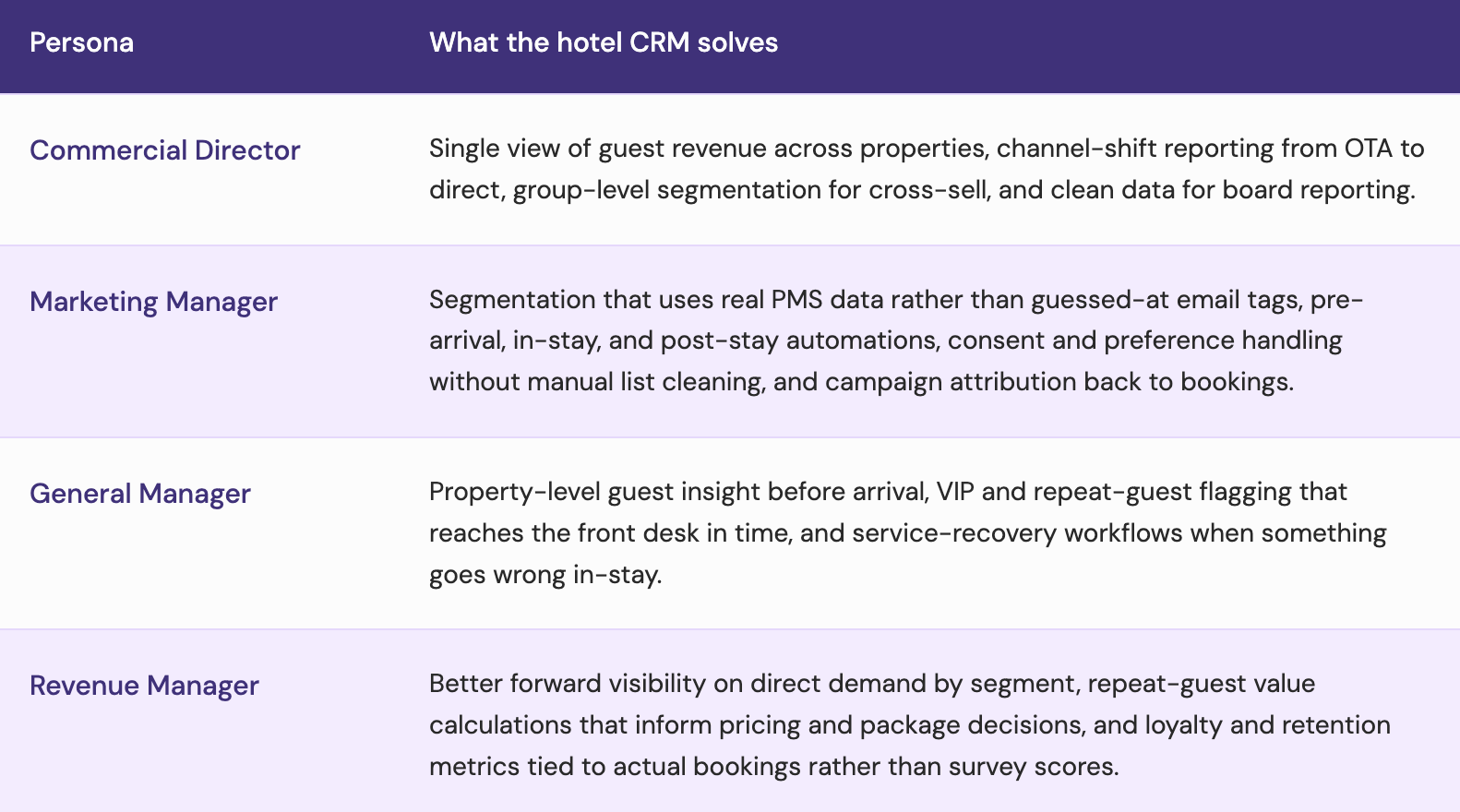
For most European mid-market groups, the starting point is a baseline of spreadsheets and basic email tools, with no real CRM underneath. The lift from that baseline to a unified hotel CRM is where the commercial gain lives, because direct channel share, repeat-guest rate, and pre-arrival upsell all start moving once the data finally connects. For ideas on how to actually use that connected data, see our guide to guest segments every hotel group should be using.
Most European mid-market groups end up evaluating three categories of CRM, each with its own trade-offs.
Generic global CRMs like HubSpot or Salesforce are flexible and well known, but they weren't built for hospitality data, PMS integrations, or GDPR-by-default operations. They can work for sales pipelines, but they require months of configuration to handle guest data properly.
PMS-native CRM modules are the CRM features bundled inside a property management system. They're convenient and pre-integrated, but typically thin on segmentation, automation, and multi-property logic. For a single property, they can be enough. For a group of 10 or more, they usually aren't.
Hospitality-purpose-built CRMs are designed for guest data from the ground up. They integrate with major European PMSs, operate under EU hosting and GDPR rules by default, and handle the multi-property segmentation that mid-market groups actually need. For a 10 to 50 property European group, this is almost always the right category.
For a deeper comparison of the options and what to look for, see our hotel CRM and email marketing guide.
.jpg)
What is a hotel CRM?
A hotel CRM is the system that unifies guest data from your PMS, booking engine, and direct channels into a single profile per guest. From there it segments those profiles, automates communication across the guest journey, and feeds insight back to operational teams. It is built for guest relationships, not sales pipelines.
How is a hotel CRM different from a generic CRM like HubSpot or Salesforce?
Generic CRMs are built around accounts, deals, and pipelines, whereas a hotel CRM is built around guest profiles, stays, and stay history. It integrates natively with PMS systems like Mews, Opera Cloud, Apaleo, and Protel, handles GDPR by default, and supports the segmentation logic hotels actually use day to day.
Do I need a hotel CRM if my PMS already has a guest profile section?
A PMS profile records the operational data needed to deliver the stay, while a hotel CRM adds the marketing, segmentation, automation, consent, and multi-property logic on top. The two complement each other, and the CRM is what turns the PMS profile into a guest relationship that drives repeat direct bookings.
Is a European hotel CRM different from a US one?
Yes. European hotels operate under GDPR, which shapes consent, retention, and data-residency requirements, and EU hosting matters for many legal and IT teams. European mid-market groups also tend to use PMS such as Mews, Apaleo, Opera Cloud, and Protel rather than the US-dominant PMS landscape, so a CRM built for those realities saves months of configuration work.
How long does it take to implement a hotel CRM?
For a European mid-market group, a hospitality-native implementation usually takes four to eight weeks, depending on PMS integration complexity and data hygiene. Generic CRM implementations in hospitality often run six months or more, because the integration and data-modelling work has to be done from scratch.
Can a hotel CRM increase direct bookings?
A hotel CRM does not buy traffic, but it does increase the share of guests who return directly rather than rebook through an OTA. By segmenting past guests, automating relevant pre-arrival and post-stay communication, and tracking repeat-guest revenue, a CRM lifts the percentage of bookings coming through owned channels.
What integrations should a European hotel CRM have?
At minimum, two-way PMS integration with European systems such as Mews, Opera Cloud, Apaleo, and Protel, plus connections to your booking engine, email, SMS, and WhatsApp providers. Many groups also connect POS, review platforms, and Wi-Fi capture, and in practice the integration list matters more than the feature list.
If you run a European hotel group with 10 to 50 properties, the question is rarely whether you need a hotel CRM, but whether the one you choose was built for your PMS, your guests, and your regulator.
Bookboost is built for European hospitality, hosted in the EU, and integrated deeply with European PMS such as Mews, Opera Cloud, Apaleo, and Protel. It's designed for groups moving from spreadsheets and basic email tools to a single guest record. Book a 30-minute walkthrough and we'll show you what your guest data looks like once it stops living in five places at once.
Are you ready to increase your revenue and build lasting guest relationships? Take the first step today.

.jpg)