If you ask a CRM vendor what their tool can't do, most will find a way to avoid answering. So here's ours, straight away: Bookboost is a B2C hotel CRM. If your group does serious events, weddings, and corporate functions, you'll probably need a separate B2B sales CRM running alongside us. For most European mid-market groups, that's the right setup, not a compromise. Once you're clear about what you actually need each tool to do, you stop trying to cram everything into one.
Hoteliers keep getting sold one tool that promises to do everything, but no product really does. B2B and B2C are just different kinds of work.
B2C in hospitality means the guest. One person, a couple, or a family books a room, stays, and maybe comes back next year. Here the CRM's job is to recognise that guest across stays, message them at the right moments, keep the database segmented, and feed clean data back to revenue management. What you're really managing is the guest profile and the lifecycle around it.
B2B in hospitality means the buyer who books on behalf of others: a corporate travel manager, a wedding planner blocking 40 rooms, or an association running a multi-day conference across two of your properties. Here the job is opportunity-shaped, moving from lead to qualified opportunity to proposal, contract, and renewal. What you're managing is the deal and the account it sits inside.
These aren't the same job. The data looks different, people use the tool differently, and they need different reporting. A B2C hospitality CRM won't run your events pipeline, no matter how many features you bolt on.

Before you compare tools, work out where your revenue and your workload actually sit. Quick test: count the room nights that come from individual guests versus contracted blocks, then count the hours your team spends on guest communication versus proposals and function sheets. For most European mid-market groups, the guest side wins both counts by a wide margin, and that tells you where the CRM money should go first.
If events and corporate are a real chunk of revenue, that's a second motion you need to tool for, not a feature to bolt onto the first.
Open any HubSpot or Salesforce instance and the furniture's the same: companies, contacts, deals on a pipeline, stages from lead to closed-won, revenue forecast by close date, and account hierarchies that roll subsidiaries up into a parent group.
That's exactly what an events or corporate sales team needs. A wedding lead runs a clear pipeline: enquiry, site visit, proposal, contract signed, event delivered. A corporate rate negotiation has a close date you can forecast and a renewal every year. Generic CRM was built for this world, and it does the job well.
What it doesn't do well is the guest. A leisure guest isn't a deal: there's no proposal stage, no negotiation, no close date. Try to force a guest into a deal record and you end up with one of two things: a graveyard of "leads" nobody updates, or a custom build so heavy it stops being the off-the-shelf tool you paid for.
A hospitality CRM is built around the guest profile, not the deal. That profile pulls from your PMS, booking engine, website, wifi captive portal, and post-stay survey, and it deduplicates across stays so one guest is one record instead of seven. It carries preferences, stay history, language, consent status, and lifetime value.
Around that profile, the lifecycle is the workflow: pre-arrival messaging timed to check-in, on-property nudges, post-stay surveys, win-back campaigns, and loyalty triggers based on how often someone stays and how much they spend.
And the reporting is segmentation-first, not pipeline-first. How many DACH guests have stayed in the last 18 months? What's the open rate on the German-language pre-arrival series for stays over three nights? None of that fits into pipeline stages. In most mid-market European groups, the revenue, the records, and the communication all sit on the guest side. The B2B side matters, but it's a small slice of the total relationships you're managing.

If you're a single boutique with no function space, B2C is the whole story: a guest CRM does the job and there's nothing else to build. But a city-centre business hotel with a real corporate share, a country house with a full wedding book, or a small group running events across several properties has two commercial motions going at once, and they need two tools.
Here's the architecture that works today.
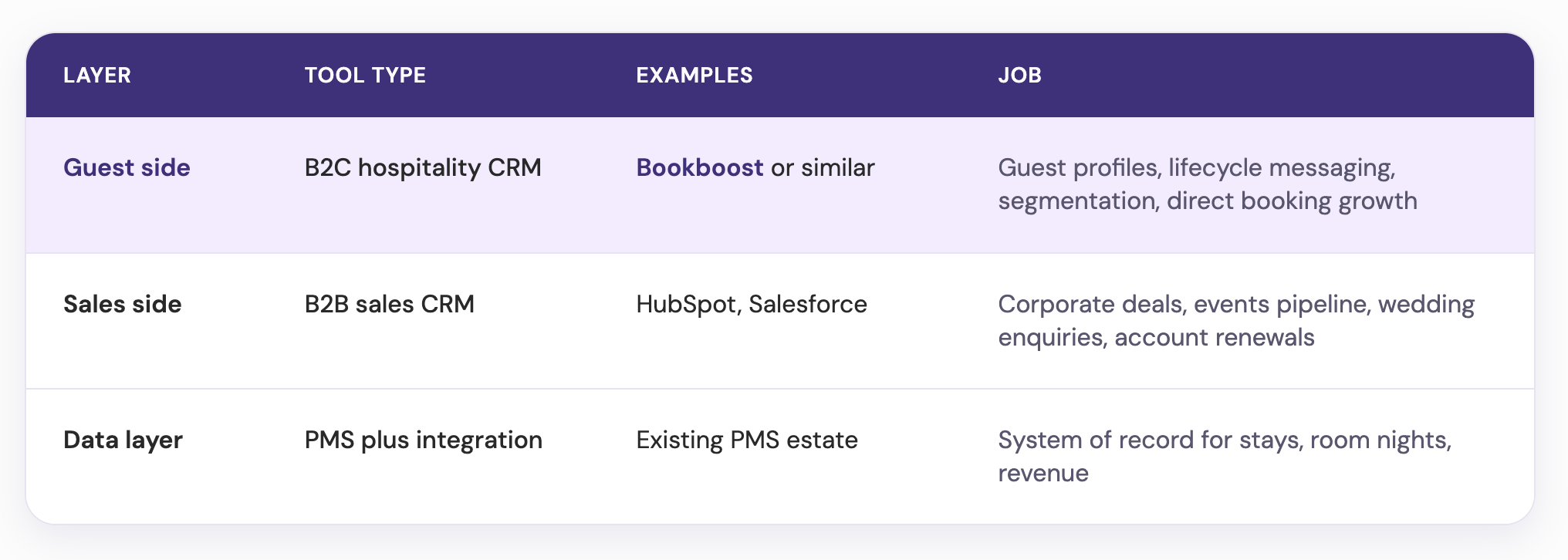
Here's what that looks like in practice. Say you're a three-property group with a busy wedding and conference book. On the guest side you run a B2C hotel CRM: every leisure and direct booker flows into one profile, gets the pre-arrival and post-stay journey, and drops into segments for your seasonal campaigns. Alongside it, your events team runs a B2B sales CRM, where every wedding and corporate enquiry is a deal with an owner, a close date, and a forecast. The PMS sits under both, so a couple who marries with you and comes back for a weekend a year later is one guest record on the B2C side and one closed deal on the B2B side. Neither tool has to pretend to be the other.
The two tools connect at the data layer instead of being crushed into one product. The guest CRM owns identity and communication, the sales CRM owns opportunities and forecasting, and the PMS stays the system of record for what actually happened on property. McKinsey's research found that 71% of consumers expect personalisation and 76% get frustrated when they don't get it, and that expectation lands overwhelmingly on the guest side.
And less needs to flow between the two than people expect. Your sales CRM doesn't need the full guest database, and your guest CRM doesn't need every line of a function contract. What matters is that guest identity and stay history live in one place, deals and forecasts live in the other, and the PMS reconciles the two. Trying to sync everything both ways is usually how integration projects stall.
Force both motions into a single tool that was really built for one of them, and the other one suffers. Push guest marketing through a B2B CRM and you get low engagement and a lot of admin. Push an events pipeline through a B2C CRM and you get half-empty records and revenue you can't forecast.
.jpg)
If you're scoring vendors right now, split your requirements into two columns: guest-side in one, events and corporate in the other. Then ask each vendor which column they're actually built for. Anyone who claims both with a straight face is overpromising.
So don't ask a B2B CRM to handle pre-arrival messaging at scale, don't ask a B2C CRM to forecast wedding revenue, and don't buy a single platform on the promise of a module that's coming later.
Here are three questions cut through most sales decks: is the core object a guest profile or a deal, does the tool segment on stay behaviour or forecast on close date, and can the vendor show you a live example with data shaped like yours instead of a generic demo? Buy the tool that fits the motion you've got, and connect it cleanly to the one that fits the other.
If you're early in the evaluation, the hotel CRM for European hotel groups guide covers the full picture. And when you want to see what the B2C side looks like in practice, book a Bookboost demo and we'll show you the guest layer running on your own data.
Are you ready to increase your revenue and build lasting guest relationships? Take the first step today.

.jpg)